Wednesday, 19 April 2023

Ten Poems about Wine from Candlestick Press

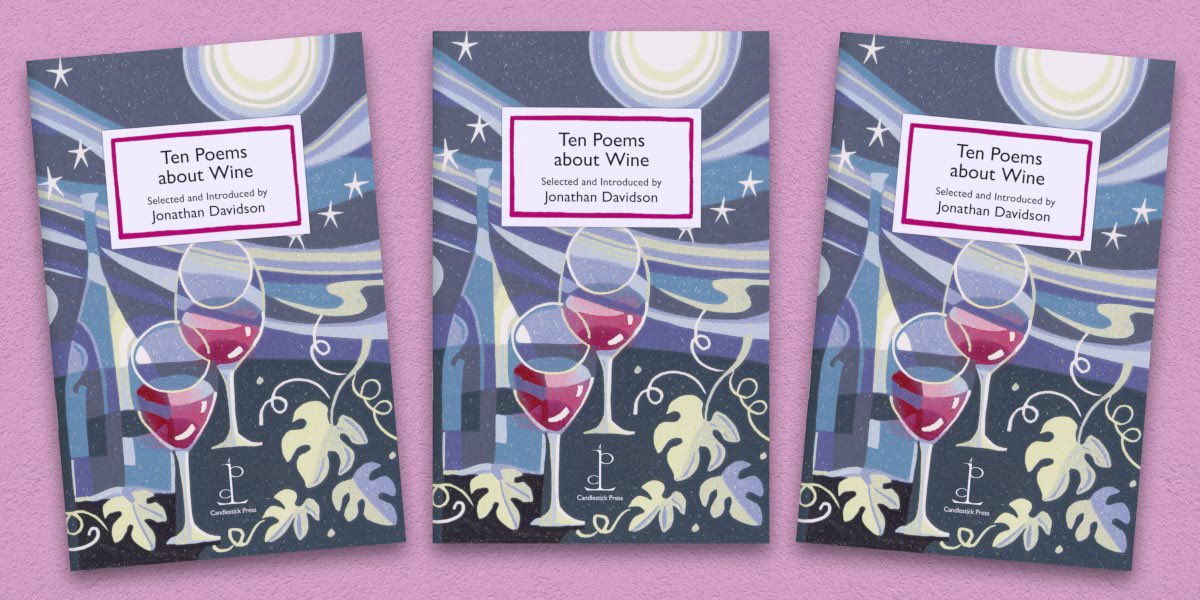
I have a poem, titled La Vendimia, in the new pamphlet/mini anthology from Candlestick Press, Ten Poems about Wine.

I'm grateful to the editor, Jonathan Davidson, for having selected my work, and it's especially pleasing to appear alongside such a star-studded cast. You can get hold of your copy via this link, while here's a photo of the pamphlet in all its glory...


Monday, 17 April 2023

A celebration of Sphinx Reviews (2006-2023)

Sphinx Reviews is a project that has run alongside HappenStance Press since 2006 (see its website here). Founded by Helena Nelson and co-edited for the last six years by Charlotte Gann, it specialises in reviews of poetry pamphlets, a format that has long struggled to receive critical attention, and provides an incredible service to poets, publishers and, of course, readers.

By my tedious manual count, a total of 1461 books have been reviewed on Sphinx, many of them by more than person, the equivalent of over 2,000 pamphlets that were received by Helena Nelson, repackaged and sent back out to her loyal band of reviewers. 2,000 batches of stamps to be paid for. Umpteen treks to the post office. 2,000 reviews that were edited by her (to the huge benefit of the reviewers themselves, whose prose style and critical approach to poetry were often transformed via this process). 2,000 posts that were formatted, uploaded and optimised for search engines.

What’s more, for many poets, the review of their pamphlet on Sphinx was the only critical response they’d ever receive. That’s a hugely generous gift in anyone’s language. Looking back at the archive, there are a fair few poets who have sadly died in the intervening years, though their reviews on Sphinx remain. As a record of pamphlet poetry in the U.K., it’s irreplaceable.

And now, of course, Sphinx is coming to an end. Helena Nelson has given so much to poets over the years via Happen
Stance Press itself and via Sphinx Reviews, in both cases to the detriment of her own writing, but even this labour of love must inevitably be finite.

Like so many positive presences in our lives, Sphinx has probably come to be taken for granted, as if it were destined to accompany pamphlet publishing forever. It will be sorely missed once poets and publishers bemoan the absence of alternatives. However, its online archive is to be cherished and celebrated. Here’s hoping that in the aftermath of this closure, we at least start to see more of Helena Nelson’s exceptional poetry…!

Monday, 10 April 2023

Understated but resonant, John Lynch's These Days

From the title of the book itself to the titles of the individual poems, from the tones and colours of the cover to the absence of blurbs, from the syntax to the semantics employed in the poems, pretty much everything about John Lynch’s first full collection, These Days (Garlic Press, 2022) feels understated.

As a consequence, especially bearing in mind that current trends in the poetry scene seem to be heading in an opposite direction, it might not come as any surprise that
These Days seems to have flown under the radar. In fact, there don’t seem to be any other reviews available online at the moment. However, a closer look demonstrates that Lynch’s poems are very much worthy of recognition.

The poems in this collection work in tandem and build their effects when read together, their emotional impact gradually accumulating, page after page. Any quote from them inevitably fails to do them full justice, but the last two stanzas of
‘Vent’ give an indication of their latent power...

…One evening, in the kitchen
I found her scraping what he’d said
wasn’t cooked into the bin,
then she opened the window wider
to let out all the steam.

A tub of Peter’s vanilla ice-cream
amongst the cutlery and saucepans
on the draining board,
she stood staring out,
scooping up mouthfuls with a tablespoon.

Of course, on first reading, this feels like a quintessential kitchen-sink drama! However, there’s a complexity to these lines via the details that are layered to make the scene come alive, while a subtle music also gathers force, especially in the final stanza, in which the final two lines are of particular interest.

From the penultimate line onwards, Lynch’s cadences step up a gear, the soft consonants interspersed with explosions, the aural patterning of the vowels in ascendance. And then the pent-up emotion comes to a climax in the shortened penultimate line before its release in the longer final line, 
a metaphorical ‘vent’ with an implicit reference to the poem’s title, thus complementing and contrasting with the more obvious physical ‘vent’ of the previous stanza. In this context, deft juxtaposition extends the poem's reach.

As is made clear by the above extract, Lynch’s unassuming approach is actually underpinned not only by a deep understanding of the ties between meaning and language, but also demonstrates an unexpected capacity for deploying sophisticated technique when required to make a poem lift off.
These Days is a collection with emotional depth that’s capable of generating its own poetic worlds. Prejudices and fashions might put many readers off, but John Lynch is a skilled poet whose work resonates. Thoroughly recommended!
Sunday, 26 March 2023

A celebration of poetry editors

Close editing is an act of colossal creative generosity, one of the best gifts a poet can receive. It's no wonder that such scrupulous, time-consuming attention is becoming less and less commonplace, but a top-notch poetry editor is worth their weight in gold and very seldom valued.

Stanza by stanza, line by line, word by word, comma by comma, a good editor enables a poet to understand their own method, makes them question and/or justify their choices, helps them spot their own weaknesses, encourages them to raise their game a notch. Such close editing places a draining demand on the person who does it, requiring a high level of engagement. It takes so much out of the editor that they often struggle to sustain their own writing at the same time. And this sacrifice is another reason why editing is generous.

Helena Nelson at HappenStance Press is the editor I know best, and her example is the point of departure for this post. Few publishers work as closely with their poets. What's more, her graft on others' behalf is definitely detrimental to her own terrific poetry. I’d suggest that U.K. Poetry could do with a few more Nells, though she's a one-off. In fact, you could do far worse than get hold of her latest top-notch collection, Pearls, which hasn’t received the attention that it so richly deserves. It’s available to purchase here.

Monday, 27 February 2023

Delicious tensions, Clare Best's End of Season/Fine di stagione

Clare Best’s new project, End of Season/Fine di stagione (Frogmore Press, 2022), is a delicious portrayal of the tensions that run through life, yoking them to poetry so as to burrow down to the core of feelings.

To start with, as indicated by the title itself, there are linguistic tensions, each poem in English placed on the opposite page to its corresponding piece in Italian (written by Franca Mancinelli and John Taylor). Rather than translations, these feel like two independent texts that establish dialogues: views of Italy in English, then also in Italian but filtered through an English perspective. Languages, cultures and societies rub up against each other and generate further insight into how we view the world around us.

And then another inherent semantic tension exists in that title. The end of a season hints at the end of a cycle, wondering and worrying about what might lie beyond, the past providing a counterpoint to the present as in the following extract from
‘Return’…

If I forget these short days
and cool nights, the lack
of screaming swifts,
I can pretend today is summer
and we are here together…

In
End of Season/Fine di stagione, Clare Best provides an acute reminder that the acts of writing and reading reconcile us with ourselves, Throughout these poems, she explores this process, leading up to ‘On the Mulattiera’, which delicately brings the past and the present back together…

…There was a time I couldn’t have left you.
I’m there, I’m here. The road’s collapsed.

Where have I been? My path – October
wood-smoke, pine cones fallen on rubble.

You let me go and then I let you go.
I never loved you well enough till now.

Fractured sky opens into rain.
What can it mean to be here, alone…?

And one final implicit tension in
End of Season/Fine di stagione is between the written page and song, as six of these poems have been set to music by Amy Crankshaw (you can watch the first performance for yourself on YouTube here). It’s well worth comparing the versions, as they cast a fresh perspective on each other.

End of Season/Fine di stagione
shows us (yet again!) Clare Best’s unquenchable thirst for collaborations with other genres, all tied to her drive to explore experience via hard-won artistic creativity, taking us along for the ride, allowing us to reflect too on the tensions within our own lives. This is the sort of writing that earns new readers for poetry, bringing it into settings and contexts where it is too often absent. Clare Best never lives in a bubble. She’s forever reaching out to people and that’s a terrific virtue.

Thursday, 23 February 2023

Edmund Prestwich's poetry blog

Certain regular readers of Rogue Strands have complimented me on the number of poetry blogs I manage to follow (or insinuated that I've got far too much time on my hands!), but I continue to make new discoveries of excellent, long-running poetry blogs that have previously slipped under my radar.

This is at once annoying and terrific. Annoying because it makes me feel useless. Terrific because each discovery provides me with the chance to devour a whole back catalogue of interesting posts.

One such case is Edmund Prestwich's poetry blog (follow this link to read it), which is packed with in-depth reviews that get down to the nitty-gritty of books such as Hannah Lowe's The Kids, Maurice Riordan's Shoulder Tap and Gerard Woodward's The Vulture, alongside nuanced analysis of poetry from the past, especially from the 20th Century. All in all, it's a treasure trove of points of departure for poetic discussion and debate. Thoroughly recommended and it's going straight on my Poetry Blogs List. I can only apologise for not having found it earlier...!

Monday, 13 February 2023

U.K. Poetry Podcasts - a list of resources

Back in December, I was delighted to be the guest poet on the Planet Poetry Podcast, hosted by Robin Houghton and Peter Kenny. Round about the same time, I began to notice more and more podcasts appearing in my newsfeed on social media, many of which had been running for some time but had slipped under my radar. And then there were comments from my mate Mat Riches about this and that interview or feature that he’d heard on this or that podcast.

And so I started to explore the scene, asking for recommendations on Twitter, realising that while I don’t have the joy of a commute, I do have hours batch-cooking in my kitchen without access to live radio in English – a perfect opportunity to work my way through a fair few poetry podcasts. I quickly found that not only is there a thriving scene, but it’s growing all the time.

As a consequence, I thought it might be a good idea to collate those podcasts in one blog post, just as I bring together U.K. Poetry Blogs annually in December, so here’s my first list of U.K. Poetry Podcasts, together with a link to each. Of course, most are available across multiple platforms. I've just selected one here for each podcast, but it should be pretty easy for you to locate them via a quick search on your brand/channel of choice…

Planet Poetry Podcast. As mentioned above, I’m hardly objective, but Robin Houghton and Peter Kenny run an excellent and invigorating ship.

The Seren Poetry Podcast. Lots to savour here from the Welsh Poetry Publisher par excellence, but I especially enjoyed the episode with Ben Wilkinson.

Versify is a terrific poetry podcast, accessible, educational, contemporary but also looking back at major figures of the 20th Century.

The Poetry Bath is presented by Sian Thomas and each episode of this radio programme-cum-podcast features an in-depth interview with a different poet.

A Mouthful of Air is run by Mark McGuinness.

The Poetry Society also have their own podcast.

Frank Skinner's poetry podcast. Nuff said.

The Poetry Exchange talks to people about a poem that has been a friend to them.
In exchange, this unique podcast creates a gift for them, a bespoke reading of their chosen poem inspired by the conversation.

Poetry to your Ears has a focus on sharing the diversity of contemporary poets.

Poetry Pause is run by Philippa Davies.

The Poet Laurensen has gone to his Shed is a personal podcast that’s hosted by Neil Laurensen himself, and the name is a nod to...

The Poet Laureate has gone to his Shed, Simon Armitage for the BBC.

Words that Burn is run by Ben Collopy, and invites you along If you want to learn just a little bit more about poetry, in a gentle calm way that won't overanalyse.

The Penteract Podcast is hosted by Anthony Etherin.

Eat the Storms might be Irish in origin, but it features many U.K. poets.

Faber Poetry Podcast is, as the name itself indicates, run by F&F themselves.

The Ted Hughes Society Podcast pretty much does what it says on the tin!

Tiny in all that Air is the Philip Larkin Society podcast.

Arji's Poetry Pickle Jar

The Scottish Poetry Library's podcast

The Alternative Stories podcast

And just like in my annual Poetry Blog List, I’m aware this post is subjective and partial. In fact, I’d be delighted if you could make suggestions of more U.K. Poetry Podcasts that I could add to it. If you know of any, please do let me know!